

I hate being asked “what do you do?”
For some, it’s easy: name, title, company.
For me, it’s not.
Yes, I am employed. I work in product marketing at Pegasystems.
But that’s not all.
I have a PhD in philosophy and an MA in sociology. I am a published author and run a growing scholarly press: Felice Mosca Press.
I founded the industry news site Biochar Today.
I operate a horse farm with my wife (Wallace Eventing) who rides and competes at the highest levels of equestrian sport.
I have been a radio DJ and podcast host. I studied music in college and have played in a number of bands cutting across country, jazz, and rock genres.
All this (and more) are not points of pride. In fact, I’ve often viewed my breadth as a problem. People — including employers — often have a tough time knowing what to do with me because my skills and aptitudes don’t narrowly conform to the contours on any one specific role.
When asked what I do, I will often refer to myself as a ‘restless dilettante,’ because that’s kind of how I view myself: jack of all trades, master of none.
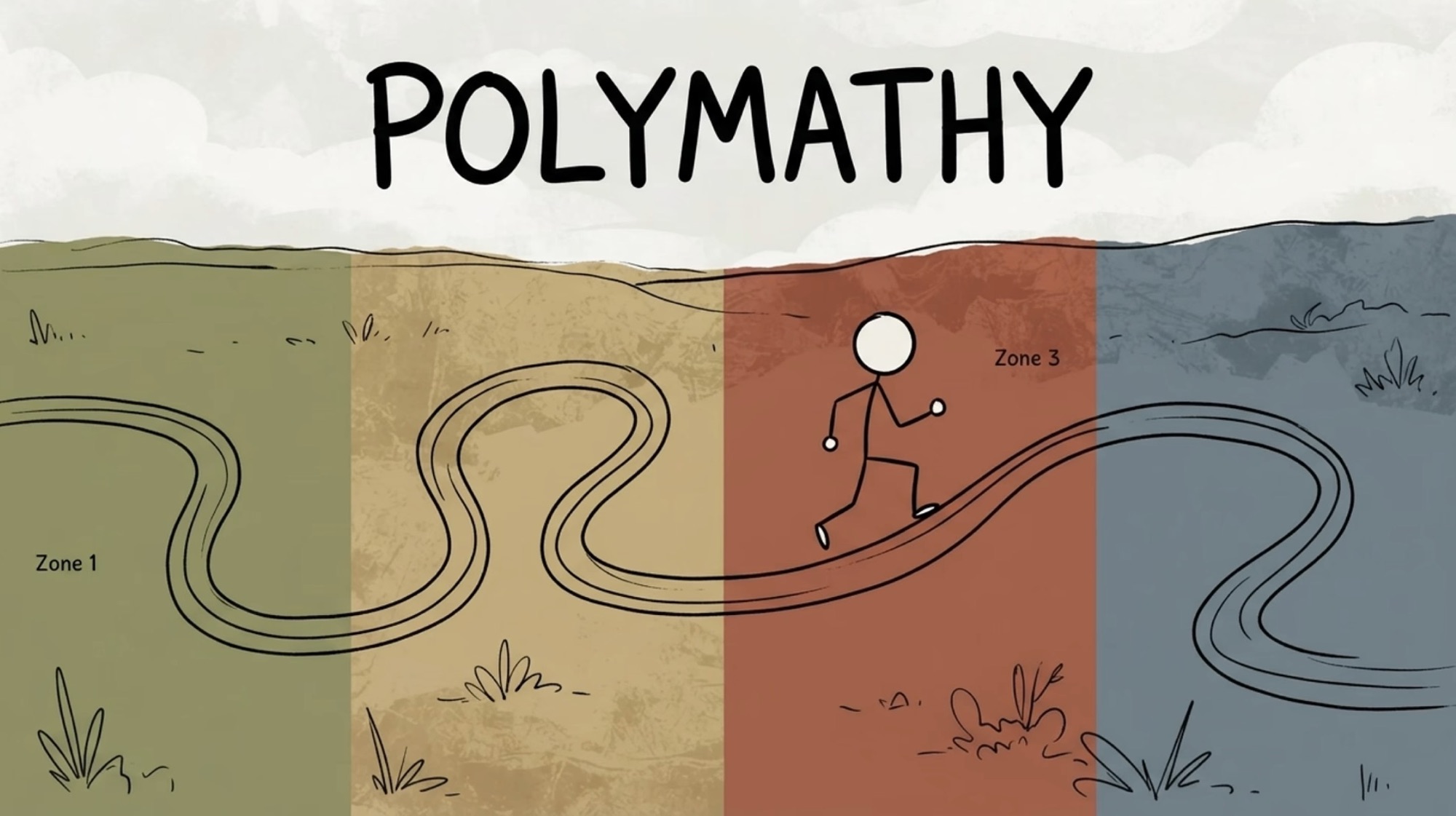
I recently came across this video explaining what a ‘polymath’ is. It’s not a term that I would ever traditionally apply to myself. It sounds pompous and hyperbolic. I still would not refer to myself in that way, for that reason. But it is a helpful concept nonetheless because it distinguishes what I do from the dilettante, and from the ‘collector’ who starts hobby after hobby after hobby without actually completing anything.
A polymath’s ’super power’ is the ability to make connections between seemingly disparate things in order to solve problems here and now. It’s what the Renaissance Humanists referred to as ‘ingenium’ (from which we derive the words ‘ingenuity’ and ‘engineering’ in English).
As access to information becomes easier and easier, the skills of the polymath — being able to make ingenious connections between things — becomes increasingly important. And yes, something I see more and more are people who are outsourcing their actual THINKING. By outsourcing our ingenuity, we reduce metaphorical thinking to the mean (LLMs function by mapping typical relationships between words; they are not good at mapping atypical relationships — which is where metaphors come from).
Here’s my prediction: the future will be one in which polymaths are increasingly rare. ‘Cuz it’s hard. Truly, I don’t know if I would have achieved half of the thugs I had if I had grown up with the internet, let alone with LLMs.
But it will also be one in which those who are willing to invest the time and become reasonably expert across several fields become the most valuable commodity…and lead.
To paraphrase Giambattista Vico, you only know a thing to the extent to which you make it. In a future where most people are relying on agents to do their thinking, only the makers — those who get their hands dirty and are able to create things for themselves — will truly know.

